The Latest Scoop on the Snowplow
Scoop
Maintenance departments planning for next winter’s
snowstorms might want to consider using snowplow scoops. This simple device,
which attaches to plows that are mounted on the front of large trucks,
can make plowing more efficient in those areas that receive lots of dry
snow.
 The
snowplow scoop, which was developed under the Strategic Highway Research
Program (SHRP), was designed to reduce the amount of energy needed to push
a plow through dry snow. Conventional plows operate at almost a 90-degree
angle to the surface of the road. The snowplow scoop, in contrast, attaches
to the front of the plow blade at a roughly 45-degree angle to the pavement
and rides slightly above the surface of the pavement. This angle makes
it easier for the snow to flow smoothly from the pavement and across the
plow. The result is a two-pronged attack on snow: the snowplow scoop picks
up the top layer of the snow, and the plow cutting edge removes the snow
left behind on the surface of the pavement.
The
snowplow scoop, which was developed under the Strategic Highway Research
Program (SHRP), was designed to reduce the amount of energy needed to push
a plow through dry snow. Conventional plows operate at almost a 90-degree
angle to the surface of the road. The snowplow scoop, in contrast, attaches
to the front of the plow blade at a roughly 45-degree angle to the pavement
and rides slightly above the surface of the pavement. This angle makes
it easier for the snow to flow smoothly from the pavement and across the
plow. The result is a two-pronged attack on snow: the snowplow scoop picks
up the top layer of the snow, and the plow cutting edge removes the snow
left behind on the surface of the pavement.
The snowplow scoop has several benefits. Because
it helps the snow flow smoothly onto the plow, the plow truck can operate
at faster speeds, is easier to control, and is more fuel efficient than
it would be with a standard plow. And because the snow flows up the plow
surface in a sheet, rather than in chunks, there is less snow cloud around
the plow, which means that visibility is improved for both the plow driver
and nearby motorists.
The snowplow scoop has a very specific application,
says Kynric Pell of the University of Wyoming, who developed the device.
"The snowplow scoop was designed for nearly vertical plow blades and
for use in dry snow," he says. "In addition, the truck should
ideally be running at 45 mi/h [72 km/h] or so. It’s meant for open highway
in areas that receive large amounts of dry snow."
The experience of the Mono County (California) Public
Works Department confirms the snowplow scoop’s usefulness in the right
conditions. The county, located high in the Sierra Nevada mountains, gets
both dry snow and wet snow.
"Last winter, we had one storm with cold, dry
snow, and the snowplow scoop performed as we had been told it would,"
says Ran Berlin of the county Public Works Department. "It picked
the snow up better and got it out of the way of the truck better, improving
visibility. But in wet snow it was a disadvantage, as snow got packed between
the scoop and the plow." This prevents the plow’s cutting edge from
effectively clearing the snow that is not picked up by the snowplow scoop.
The operator must then stop and clear out the snow.
Berlin also notes that the snowplow scoop was most
effective on open highways where the plow truck could travel at speed.
The scoop is also better suited to rural roads because it is made of a
plastic that wears quickly when used on city streets with manholes, curbs,
and other obstacles.
Mono County was one of 59 State highway agencies,
local governments, tribal governments, and transportation technology transfer
centers that offered to evaluate the snowplow scoop last winter. The Federal
Highway Administration (FHWA) contracted with Riveer Co. of Saugtuck, Michigan,
to provide snowplow scoops to those agencies.
The evaluation was initiated by former SHRP staff
members John Hibbs and Shashikant Shah as part of an FHWA project to introduce
local governments to SHRP products (see April 1997 Focus). Hibbs
says the results of the evaluation are still out, as few agencies have
sent in their comments, possibly due to the mild winter weather in much
of the country.
FHWA also gave away 10 snowplow scoops at the Eastern
Winter Road Maintenance Symposium and Equipment Expo last September. And
State highway agencies in New Jersey, Ohio, and Texas began evaluating
the device last fall as part of an FHWA test and evaluation project.
FHWA’s Ray McCormick says, "I encourage users
to send me any comments they may have. We’re eager to know how well—or
how badly—the snowplow scoop worked."
For more information or to comment on the snowplow
scoop, contact McCormick
at FHWA (phone: 202-366-4675; fax: 202-366-7909; email: ray.mccormick@fhwa.dot.gov).
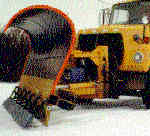
The snowplow scoop, shown here mounted to the
front of an experimental plow, can make plowing operations more efficient
in areas that receive a lot of dry snow.
Back to August 1997 - List of Articles
 This
page was created with Netscape Navigator Gold
This
page was created with Netscape Navigator Gold
This page last updated on August 10, 1997.
Published monthly by the Federal Highway Administration, U.S. Department
of Transportation.
To subscribe, send name, address, phone &
fax numbers to 104177.370@compuserve.com.