New Calibration Procedure Solves
South Africa’s FWD Woes
If two devices that measure the same properties produce
dramatically different results, how do you know which is right? The South
African Department of Transport (DOT) faced exactly that problem when the
country’s two falling weight deflectometers (FWD) began generating dramatically
different readings in 1993. Extensive tests failed to explain the difference,
making it impossible to know which was supplying incorrect data. The DOT
called off all further deflection testing until the problem could be fixed.
 Louw
Kannemeyer of the South African DOT suggested that the solution might be
the reference calibration procedure, which was developed under the Strategic
Highway Research Program (SHRP) for use by the long-term pavement performance
(LTPP) program. Kannemeyer knew that highway agencies in the United States
had set up regional calibration centers to solve similar problems. The
calibration procedure involves comparing readings from an FWD against independent
references that meet National Institute of Standards and Technology benchmarks.
Louw
Kannemeyer of the South African DOT suggested that the solution might be
the reference calibration procedure, which was developed under the Strategic
Highway Research Program (SHRP) for use by the long-term pavement performance
(LTPP) program. Kannemeyer knew that highway agencies in the United States
had set up regional calibration centers to solve similar problems. The
calibration procedure involves comparing readings from an FWD against independent
references that meet National Institute of Standards and Technology benchmarks.
The DOT followed Kannemeyer’s suggestion and specified
that FWDs must be calibrated within the 2 months preceding a network-level
survey.* Rather than set up its own calibration center, the DOT required
that FWDs be calibrated by an independent organization.
As a result, the two companies providing FWD testing
on South Africa’s 7,000-km (4,300-mi) highway network teamed up to award
the South African Bureau of Standards (SABS) with a contract to construct
and operate an FWD calibration center. SABS then approached Dynatest, a
U.S. vendor of FWDs, for assistance in setting up the calibration facility
and obtaining the necessary manuals, software, and equipment. Construction
of the center, located in Pretoria, is now under way.
According to Trenton Clark of PCS/Law Engineering,
which sets up calibration centers for highway agencies and the private
sector, a growing number of countries now have FWDs, and they recognize
the need to keep them calibrated. Australia has already purchased the equipment
needed to build a calibration center, and Denmark and several other countries
have requested information on the FWD calibration procedures.
For more information on FWD calibration or on setting
up an FWD calibration center, contact Max
Grogg at FHWA (telephone: 518-431-4224, ext. 223; fax: 518-431-4208;
email: max.grogg@fhwa.dot.gov). *
*The pavement management systems used
by highway agencies differentiate between project-level testing (used for
a particular site) and network-level testing (used for an entire network
of highways).
Deflection testing is used to help highway agencies
determine the optimal strategy for maintaining and repairing pavement.
The test equipment is housed on a trailer, which is towed to the test site.
The test involves dropping a heavy weight on the pavement and measuring
how much the pavement deflects, or moves, in response.
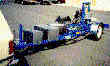
A properly calibrated falling weight deflectometer
is essential to a pavement management system.
FWD Resources
Highway agencies and others in the United States
can take their FWDs to any one of the four regional calibration centers:
- Minneapolis, Minnesota (phone: 612-779-5542; fax:
612-779-5535)
- Carson City, Nevada (phone: 702-888-7173; fax: 702-888-7501)
- Harrisburg, Pennsylvania (phone: 717-783-6857; fax:
717-783-6013)
- College Station, Texas (phone: 512-465-7653; fax:
512-465-3681)
The centers are operated by the highway agencies
in the host States.
More information on the services provided by FWD
calibration centers can be found in Guidelines
for Users of the FWD Calibration Centers (FHWA-SA-95-038). The
publication is available from FHWA’s Research and Technology Report Center
(phone: 301-577-0818; fax: 301-577-1421).
An online discussion group provides an easy means
of sharing information with, and posing questions of, fellow FWD users.
The group uses email to bring together FWD users from around the world
to discuss common concerns and improve practice. To join, send an email
message with your name, organization name, and position or title to Egbert
Beuving at E_Beuving@compuserve.com.
Back to July 1997 - List of Articles
 This
page was created with Netscape Navigator Gold
This
page was created with Netscape Navigator Gold
This page last updated on July 21, 1997.
Published monthly by the Federal Highway Administration, U.S. Department
of Transportation.
To subscribe, send name, address, phone &
fax numbers to 104177.370@compuserve.com.