
Using products of the Strategic Highway Research Program to build better, safer roads
July/August 1998
Videotapes Explain the How and Why of Laboratory Test for Resilient Modulus
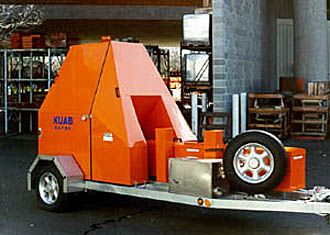
The falling weight deflectometer (FWD) is a useful
tool for measuring the resilient modulus of the subgrade at a project
site. A test procedure developed by the LTPP program makes data from
FWD testing suitable for use in pavement design equations.
The resilient modulus, or stiffness, of the soil and rock in the subgrade at a paving project is a critical factor in determining how thick a pavement should be (see sidebar below). Many highway agencies use a falling weight deflectometer (FWD) to measure the resilient modulus of subgrade materials. The FWD is towed to the project site, where it measures how the subgrade reacts to a heavy weight dropped on the ground above.
The FWD field test quickly and accurately simulates the stresses caused by traffic loads on large areas of subgrade. But the equations in the pavement design guidelines* call for the resilient modulus to be measured using a carefully controlled laboratory test on a small sample of the subgrade. The results of the laboratory test are then used to calculate a correction factor for the FWD test data, which will make the FWD test results suitable for use in the pavement design equations.
Many highway agencies are, however, hesitant to conduct the laboratory test because it is complex and can produce inconsistent results, says Max Grogg of the Federal Highway Administration (FHWA). "Many agencies are resistant to adopting resilient modulus testing because the laboratory test results have been difficult to reproduce. The intricacies of the laboratory test have also been openly and loudly debated in academia, which tends to scare off practitioners who don't want to be told they are performing the test incorrectly."To overcome this resistance, FHWA's long-term pavement performance (LTPP) program developed a standardized laboratory procedure to measure the resilient modulus of subgrade materials. The LTPP program also developed a related laboratory startup and calibration verification procedure. The procedure carefully lays out the steps involved in conducting the resilient modulus laboratory test. As a result, highway agency staff can obtain consistent results, and they no longer have to worry whether they are performing the test properly. The resilient modulus test procedure has since been adopted as an AASHTO provisional standard, "Standard Test Method for Determining the Resilient Modulus of Soils and Aggregate Materials" (TP46-94).
To help State highway agency laboratories make the decision whether to adopt the laboratory test method for measuring resilient modulus, three new videotapes have been produced by FHWA through a cooperative agreement with the Minnesota Department of Transportation.
- Laboratory Resilient Modulus Testing: Is This the Right Time?
This 8-minute videotape explains resilient modulus and
why it is important to adopt the resilient modulus test procedure.
It also explains the developments that have made resilient modulus
testing more consistent and easier to adopt. The videotape is
intended for administrators and engineers.

- Laboratory Resilient Modulus Testing: Startup and Quality
Control Procedure. This 15-minute videotape for laboratory
managers and technicians begins with a detailed definition of
resilient modulus. It then explains the procedure developed under
the LTPP program to ensure that a laboratory is set up properly
to conduct the resilient modulus test procedure and to collect
accurate test results. The procedure ensures that test results
are comparable regardless of where or when they were obtained.
- Laboratory Resilient Modulus Testing: Sample Preparation and Test Procedure. This 13-minute videotape for managers and technicians describes each of the steps in the resilient modulus test procedure, including how to prepare soil and aggregate samples.
To order the videotapes, or for more information, contact Max Grogg at FHWA (phone: 518-431-4224, x223; fax: 518-431-4208; email: max.grogg@fhwa.dot.gov).
* 1993 AASHTO Guide for Design of Pavement Structures (Publication No. C97-GDPS-4)