SHRP Products Improve Safety in
Work Zones
Temporary work zones are hazardous for motorists
and workers. The short duration of most maintenance and repair jobs, such
as pothole patching, makes it impractical to install concrete barricades
or other formidable types of protection. As a result, the crew often works
just a few short steps away from passing vehicles, with scant protection.
The sometimes confusing nature of work zones increases the risk of accidents;
drivers are suddenly faced with closed or shifting traffic lanes, backed-up
traffic, or other exceptions to normal travel conditions.
 New
work zone safety devices developed or evaluated under the Strategic Highway
Research Program (SHRP) can give workers more protection in, and help motorists
safely wend their way through, temporary work zones. To evaluate the benefits
versus costs of the SHRP devices, a panel of safety experts at the Texas
Transportation Institute (TTI) looked at two of the most widely used products—namely,
the flashing stop/slow paddle and the opposing traffic lane divider. The
flashing stop/slow paddle helps flaggers to get drivers’ attention and
instruct them to stop or slow down in a work zone. The opposing traffic
lane divider is placed along the centerline to alert drivers to a changed
traffic pattern, such as when a one-way road is temporarily converted to
two-way operation.
New
work zone safety devices developed or evaluated under the Strategic Highway
Research Program (SHRP) can give workers more protection in, and help motorists
safely wend their way through, temporary work zones. To evaluate the benefits
versus costs of the SHRP devices, a panel of safety experts at the Texas
Transportation Institute (TTI) looked at two of the most widely used products—namely,
the flashing stop/slow paddle and the opposing traffic lane divider. The
flashing stop/slow paddle helps flaggers to get drivers’ attention and
instruct them to stop or slow down in a work zone. The opposing traffic
lane divider is placed along the centerline to alert drivers to a changed
traffic pattern, such as when a one-way road is temporarily converted to
two-way operation.
In 1994, 706 people were killed in work zone accidents
in the United States. It is difficult to quantify the average value of
a human life. For the purposes of the benefits versus cost analysis, however,
TTI assigned each fatality a value of $2.7 million, a generally accepted
figure in calculating the monetary losses resulting from an accidental
death. Thus, the 706 fatalities in 1994 came at a financial cost of $1.9
billion to society. Each injury resulting from a work zone accident was
assigned a value of $24,800, with a total cost of $122 million; property
damage costs were estimated at $43 million.
The TTI panel estimated that using the flashing stop/slow
paddle and the opposing traffic lane divider at work zones around the country
could reduce the number of accidents by 5 percent. Because the vast majority
(86 percent) of people killed in work zone accidents are occupants of vehicles,
not part of work crews, TTI apportioned 86 percent of the predicted costs
to motorists (road users) and 14 percent to highway agencies.
Realizing that implementation of these two devices
would not happen overnight, TTI calculated that the savings apportioned
to State and local highway agencies could range between $2.1 million and
$4.1 million annually over a 20-year period, after subtracting the upfront
costs of purchasing the devices. The savings apportioned to motorists could
range between $15 million and $29 million per year.
These benefits more than cover the expense to highway
agencies of developing and implementing the safety devices. TTI estimates
that the cost of researching, developing, and implementing the SHRP products
will total $30 million over 20 years, or $1.5 million per year—less than
half of what highway agencies could save every year.
Case Studies
The work zone safety devices developed under SHRP
are already making life better for workers and motorists. Here are just
two examples:
- Highway agencies in Kentucky have been using the
flashing stop/slow paddles in work zones on city streets and Interstate
highways. Flaggers love the highly effective device, says John Hibbs of
the Kentucky Transportation Center. "There is one general response
after flaggers have used the flashing stop/slow paddle for a while: They
do not want to give it up."
- The Texas Department of Transportation (DOT) is
using the opposing traffic lane divider to keep drivers informed when a
one-way road has been changed to two-way operation. In addition to providing
clear instructions to motorists, the new devices are quick and easy to
install and relatively inexpensive. "Our first concern must be to
provide better service to the public," says Thomas Bohuslav of Texas
DOT. "The opposing traffic lane divider allows us to do that."
The following work zone safety devices developed
under SHRP are now commercially available:
- Flashing Stop/Slow Paddle
- Opposing Traffic Lane Divider
- Direction Indicator Barricade
- Truck-Mounted Attenuator for Chemical Spreaders
- Intrusion Alarm
- Portable Rumble Strip
- All-Terrain Sign and Stand
- Queue Length Detector
A ninth product—the remotely driven shadow vehicle—is
nearing commercial production.
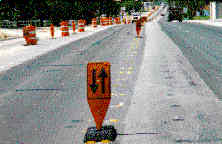
The opposing traffic lane divider alerts drivers
to traffic problems.
More detailed information on the benefits-versus-costs
analysis of the SHRP products, as well as more than 100 case studies
of how highway agencies are using those products, are available at the
RoadSavers home page.
Back to March 1997 - List of Articles
 This
page was created with Netscape Navigator Gold
This
page was created with Netscape Navigator Gold
This page last updated on April 25, 1997.
Published monthly by the Federal Highway Administration, U.S. Department
of Transportation.
To subscribe, send name, address, phone &
fax numbers to 104177.370@compuserve.com.